One Nation, No Script
Pauline Hanson wants a monoculture. Australian theatre has spent seventy years proving we can't even agree on a script - and that might be the most honest thing about us.

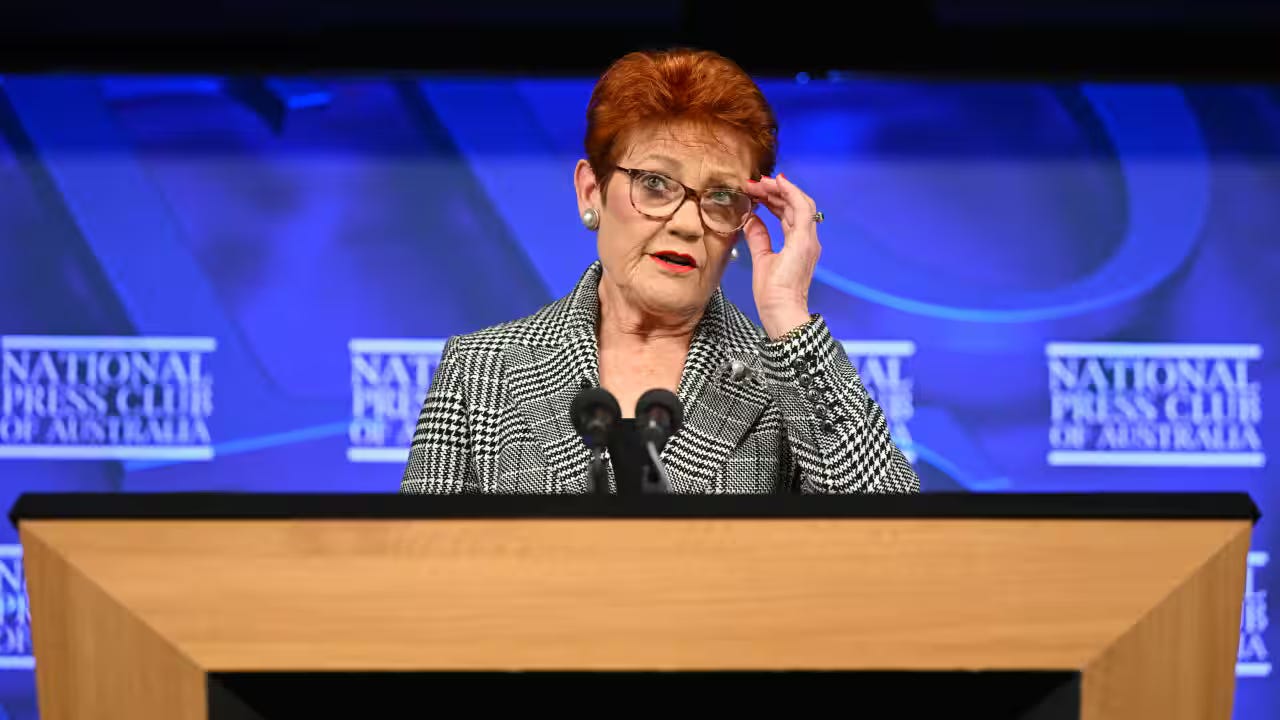
A fortnight ago, at the National Press Club, Pauline Hanson declared that “we cannot be a multicultural society. We are a multiracial society, but we must be monocultural.” Immigration, she said, had driven Australia into a state of crisis. One Nation would fight for people to “get their country back.”
What followed, was - I think it’s safe to say - a clusterfuck. The Prime Minister posted within hours that diversity is the strength of modern Australia. Angus Taylor, Federal Opposition Leader, flubbed the ball. He refused to outright denounce Hanson, opening the party to days of having to define their position on multiculturalism.
Hanson said a bunch of things in that press address - making it easier for people to get fired, ditching paid parental leave. But the monocultural statement had sticking power beyond the 24-hour news cycle.
A week later, Hanson put herself in a linguistic knot when she defended her position. Pressed on the obvious, she told parliament that the Socceroos represent her vision of monocultural Australia: “people from different backgrounds and cultures and nations all wearing green and gold.”
So: a national team built substantially by immigration and the children of immigrants, drawn from dozens of heritages, united by a jersey and a shared project.
Pauline, you weirdo, that’s multiculturalism.
The Liberals tied themselves in knots under Angus Taylor. They both wanted to denounce her without alienating the huge number of voters that had apparently left the Liberals for her party. In truth, the Liberals are very multicultural.
It was Malcolm Fraser’s Liberal government that embedded multiculturalism into Australian public life, established SBS, and resettled tens of thousands of Vietnamese refugees.
Penny Wong named this trap years ago: you can’t out-Pauline Pauline Hanson. Hanson will always say the outrageous thing, because outrage is the entire business model.
It’s easy to dismiss her when you’re an arty person on the left (which you probably are if you’ve read this far) - but Hanson’s comments point to a large wound at the heart of Aussie life.
The undercurrent
It would be comfortable to leave it there - a nutbar senator, a cowardly opposition leader, a news cycle. But the furore has unearthed something larger: a genuine, national, values-based argument about what Australian culture actually is. And parts of that argument have an undeniably racist undercurrent.
Liberal Party federal president Tony Abbott has been arguing that Australia has a “core Anglo-Celtic culture” and a “Judeo-Christian ethos that should never change” — a culture, he suggests, that deserves priority. If longevity is the measure of a “core” Australian culture, the title belongs to the oldest continuous living cultures on Earth, which have been here for some 65,000 years and were never consulted about the renovation.
Which brings us to the cognitive dissonance at the centre of the monoculture pitch. The same movement demanding a single, unified “Aussie identity” is remarkably untroubled by the fact that the First Australians live, on average, around eight years less than the rest of us. The Productivity Commission’s latest review found just four of nineteen Closing the Gap targets on track, with adult imprisonment, children in out-of-home care and suicide going backwards. You cannot preach national unity while shrugging at a gap that wide. A monoculture that doesn’t include the oldest culture isn’t unity. It’s amnesia with a flag on it.
And the public, for the record, isn’t buying the crisis narrative. The Scanlon Foundation’s 2025 Mapping Social Cohesion report - the largest ongoing study of its kind - found 84 per cent of Australians agree multiculturalism has been good for the country. Half of us were born overseas or have a parent who was.
But then…
What’s a nation, anyway?
Underneath the shouting sit older, stranger questions. The scholar Benedict Anderson famously called nations “imagined communities” - too large for any citizen to know more than a fraction of their fellow members, and therefore held together not by blood or soil but by shared story. Orwell drew a related line: patriotism is devotion to a place and way of life you have no wish to force on anyone else; nationalism is the hunger for prestige and power at others’ expense. One is love. The other is insecurity wearing love’s costume.
So can the Left be patriotic?
It is entirely possible to be patriotic and warm and open to other nations. Most Australians already are; the Scanlon data says so every year. The policy expression of that patriotism isn’t complicated, either: it looks like citizenship built on civic commitment rather than ancestry, institutions that tell the truth about our history, and a cultural sector funded to keep telling the shared story that holds an imagined community together.
Which is where my industry comes in - because if a nation is a shared story, Australia’s storytellers have been filing worried reports for seventy years.
The Great Australian Play problem
Try to name the Great Australian Play.
Go on.
The most frequent touchstone is Ray Lawler’s Summer of the Seventeenth Doll (1955): two Queensland canecutters come south for the lay-off season, as they have for sixteen summers, to the women who wait for them — and in the seventeenth summer, the whole sun-bronzed ritual collapses. Enoch and Mailman’s The 7 Stages of Grieving (1995) is cited just as essentially: a one-woman journey through the grief of colonisation, personal and societal at once.
The most common contemporary answer is Andrew Bovell’s When the Rain Stops Falling (2008), in which inherited trauma cascades down four generations like weather.
Beyond that, things get diffuse fast. And it feels rude at best — dangerously reductive at worst — to exclude David Williamson, Patricia Cornelius, Nakkiah Lui, Louis Nowra, Joanna Murray-Smith, Patrick White and countless others from the conversation. Everyone’s canon varies. We have never settled it.
Why? Look at what the contenders share. In the Doll, in 7 Stages, in Bovell — the Australian identity is not a settled thing being celebrated. It is the carrier of long-held, deep and painful wounds. There’s the comfortable larrikinism, the dry humour, the beer and the banter - and then things get dark, quickly. Our national drama keeps writing the same story: someone performing certainty about who they are while grieving something they can’t name.
It’s this spiritual darkness that Hanson and Abbott are drawing from, whether they know it or not. Desperate not to be flung into the void of “who are we, actually?”, they grab for firmer ground: a single culture, a fixed identity, a country you can “get back.” They are pointing - crudely, cruelly, but not entirely inaccurately - at a real societal wound around cultural confusion.
You can see the same wound everywhere once you look. It’s in our systematic defunding of the arts - a country unsure of its story sees little value in its storytellers. It’s in our annual January argument over Australia Day and Invasion Day, a nation unable to agree on which day it was born because it cannot agree on what the birth was.
The monoculturalists diagnose the ache correctly and prescribe poison. Their answer to “we don’t know who we are” is pick one version and legislate it. But identity built on exclusion isn’t firm ground.
There is another way through the confusion, and it’s the one every good drama eventually reaches: you don’t resolve a wound by denying it. You resolve it by telling the truth about it, in company.
The Uluru Statement from the Heart understood this precisely - that’s what Makarrata, truth-telling, is: a nation sitting down to hear its whole story before deciding what it becomes. The referendum’s defeat did not make the invitation expire. And the Socceroos - bless them, Pauline - show the destination: different backgrounds, one project, held together not by sameness but by commitment.
A jubilant, united, safe and warm Australia is not on the far side of exclusion. It’s on the far side of compassionate inclusion - an embracing of who we already are, all 65,000 years and two hundred-odd nationalities of it, wounds included. That’s not a monoculture or even, really, multiculturalism as a policy label. It’s just the honest version of the play we’re already in.
Totally agree! If only more people would read your wise words and those of others. 🤞
Amazing! Whole heartedly agree! 👏