Exit, Stage Left
Labor senators walked out rather than vote on ending $50k arts degrees

In theatre, we call it blocking - the deliberate arrangement of bodies on a stage. Where a person stands, when they move, when they leave. Nothing is accidental. An exit is never just an exit. It is a statement.
Last Thursday, in the Senate, Labor senators rose from their seats and left the chamber rather than vote on the Higher Education Support Amendment (Reverse Job-Ready Graduates Fee Hikes and End $50k Arts Degrees) Bill 2025. They didn’t vote it down themselves. They simply exited, stage left, and let the Coalition do it for them.
The bill failed. The Job-Ready Graduates fee structure - the Morrison-era policy that made an arts degree cost more than $50,000 - remains fully intact.
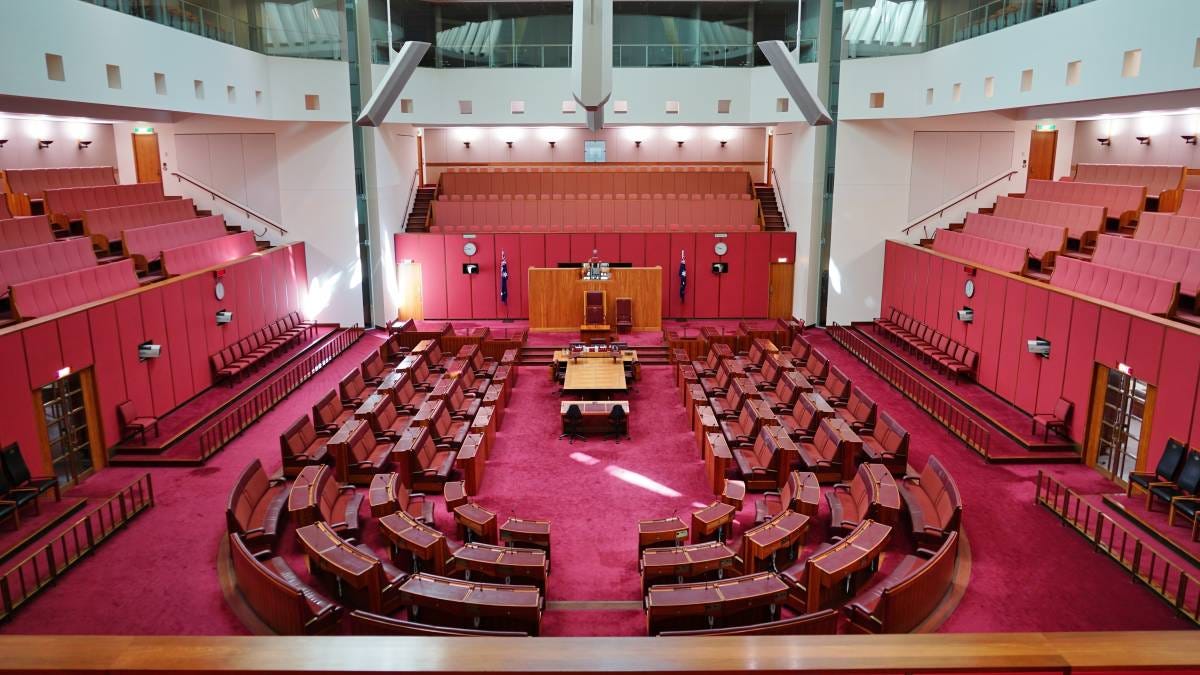
As blocking goes, it’s devastatingly eloquent. You don’t walk out of a vote you believe in. You don’t walk out of a vote you’re proud to oppose. You walk out when you know that what’s about to happen is indefensible, and you’d rather not have your name on it.
A quick refresher on the policy Labor just protected
I’ve written about the Job-Ready Graduates package before, but the details bear repeating, because they remain as absurd as the day they were legislated.
Announced in 2020 by then Education Minister Dan Tehan, JRG set differential pricing for degrees, supposedly to funnel students into “job-ready” fields. When it took effect in 2021, humanities degrees jumped 117 per cent in price overnight. A communications degree went from $6,684 a year to $14,500. The theory was that seventeen-year-olds would abandon English and history for engineering and nursing if you made the former expensive enough.
They didn’t. Analysis shows only 1.5 per cent of students changed their course choices. Students kept choosing the arts - they just graduated with roughly double the debt. The policy failed even on its own cynical terms. It didn’t redirect anyone. It just punished them.
The government’s own Universities Accord - Labor’s landmark review of the sector - recommended scrapping it back in early 2024. Education Minister Jason Clare called the Accord a “plan for the next decade.” Two and a half years on, the fee structure it condemned is still standing, and this week his colleagues left the chamber rather than dismantle it.
The people who refused to let it die quietly
Credit where it is deeply due. Senator Mehreen Faruqi and the Greens tabled the bill and have refused to let this issue disappear from the parliamentary agenda. Senator David Pocock and, in the other place, Dr Monique Ryan have consistently called out the impact of JRG and argued the simple principle at stake: a higher education system should not penalise students based on the discipline they choose to study.
The National Advocates for Arts Education - with Professor Sandra Gattenhof and Dr John Saunders appearing before the Senate inquiry into the bill - presented years of evidence documenting the damage. Saunders’ reaction to the vote captures the frustration precisely:
“We continue to hear rhetoric about building ‘a better and fairer education system’, while maintaining a policy that deliberately saddles students in the arts and humanities with substantially higher levels of debt than their peers. If fairness is the goal, this policy fails that test.”
He watched, in his words, in disbelief as Labor senators left during the vote. So did a lot of us.
This is one valve in a system that’s failing everywhere
Regular readers will recognise the pattern, because it is the same pattern I keep documenting at every level of arts education in this country.
In Queensland high schools, ATAR scaling tells a student that a perfect result in Drama in Practice is worth 47, while a perfect result in Mathematical Methods is worth 97. In our universities, more than forty creative arts degree programs have closed since 2018, while the institutions that remain shed the casual staff who connect students to the industry. And at the federal level, JRG stands as the capstone: a price signal telling every school leaver that their discipline is valued less than their peers’.
Each of these mechanisms is defended separately, with separate bureaucratic language. Together they form a single, coherent message to young people: not this. Choose anything but this.
The cruelty is that the students don’t listen - we know they don’t, the JRG data proves they don’t - so the system doesn’t change their choices. It just taxes them for making them. A student who follows their talent into the humanities will carry tens of thousands of dollars of additional debt into a housing market and cost-of-living crisis that is already crushing their generation. That’s not workforce planning. That’s a fine for loving the wrong things.
A setback is not an ending
Here is what I keep coming back to. The initial policy belongs to the Morrison government. But it has now survived an entire term - and more - of a Labor government that campaigned on fairness in education, commissioned a review that told it to scrap the policy, and then left the chamber rather than act.
The message this sends is clear. Some disciplines are simply valued less than others. Some students are simply worth less investment.
But the campaign to end JRG has something the policy has never had: evidence. Every year the data gets stronger. Every inquiry reaches the same conclusion. Every advocate - the researchers, the educators, the students, the peak bodies who have worked on this since 2020 - adds to a record that is becoming impossible to ignore. This week’s vote is a setback, but the inequities remain, and so does the case against them.
In the theatre, an exit is never the end of the story. The actors come back on. The next scene starts.
We’ll be here for it.
It's more than just a fine for what you love. It's a fine for who you are. It's not whimsy, it's identity. Just when you think Labor can't go lower...urgh